Showing posts with label Rotary Lift. Show all posts

Sunday, October 16, 2011

Wig-Wag Monocopter


Ascent position


Descent position [almost]


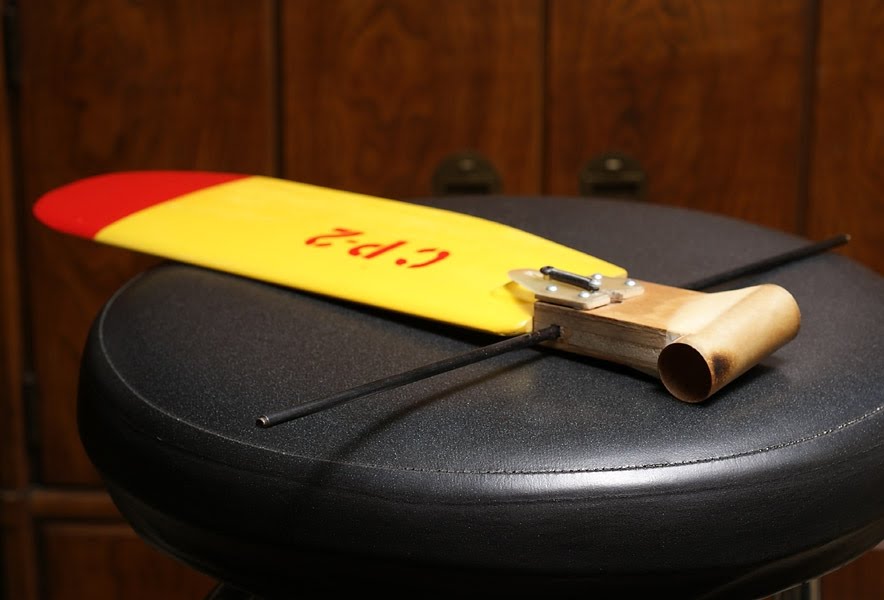
The Wig-Wag is yet another monocopter with an adjustable pitch wing. Like the two Campitch MC's the wing automatically adjusts from ascent pitch to descending autorotative pitch.

The Wig-Wag employs a weighted arm mounted to the hub and a wire loop mounted to the underside of the wing leading edge which goes around the weightbar. Before ignition, the weightbar dangles down holding the wing down with it. As rpm increases centrifigal force swings the weightbar outward, thus upward, until it's horizontal, pulling the wing up to ascent angle. After motor burn out, as rpm decreases, the weightbar sags downward again, bringing the wing down into autorotation mode. Unlike the Campitch MC's, this pitch control system is more responsive in flight and doubtless more tunable on the ground since it's controlled by the mass [and length] of the weightbar alone rather than the interaction of wing weight and spring strength. This actually works like the weight ball governor on old steam engines [and some early petrol engines], particularly stationary units. So like them, at peak performance, the Wig-wag monocopter is literally running ball[s]-out.

While the Campitch MC's would've been difficult to design without serious drafting, preferably CAD, the Wig-Wag was cobbed together a part at a time with no drafting of any sort. It aint perfect, but it's a good first attempt and entirely functional from first flight on.
The wing and hub are used parts resurrected from the remains of the CP-1. This makes for a wing that is too small and heavy but it does turn in fair flights on C motors. The weightbar is made from an RC pushrod clevis and a piece of 2-56 all-thread with a lead fishing weight nutted on. My biggest conceptual stumbling block was coming up with a suitable weightbar pivot mount on the hub. Installation of an upright piece of G10 fiberglass was easy enough with my bandsaw followed by grinding access for the flybar with a moto-tool. What was actually more difficult was bending a suitable wire loop for the wing and then mounting it in the best spot. I bent two loops and then punched three pairs of holes in the wing before I was reasonably satisfied. I was glad to be utilizing used parts as I had no concern for cosmetic issues.

So far the Wig-Wag has made three flights. First on a C6, then on a D5, followed by a D12. While the two Estes motors were fine, the Quest D5 suffered a case burnthrough. While this is no big surprise anytime you spin one, that recycled undersized wing makes matters worse. This led to replacement of the motor mount tube.

After puzzling for quite a while over a name, I settled on Wig-Wag due to the resemblance between the weightbar and a wig-wag railroad crossing signal
.

Wednesday, January 12, 2011

Beware of Rotating Parts!

At a typical modroc launch, any monocopter pads get set up nearby other pads in order to share launch control wires. I already posted about the [extremely] close call I had on the Pitchwing-2 first flight. This time it was another new monocopter called the Wig-Wag.

Right after takeoff the Wig-Wag drifted downwind slightly and the wingtip collide with an 1/8" stainless steel launch rod. The rod was mounted in the same launch rack that the Campitch-2 didn't hit. The launch rod was ruint [Texan for ruined, but with more finality], totally FUBAR! The only part of the rod that was still straight was the 1" section clamped in the pad base. One might expect the rod to be bent away from the direction of impact, or bent sharply toward DOI at the point of impact. Nope, neither. After the sharp 20-25deg bend away from DOI at the base the remaining rod length was bent in a continuous arc like a bow. quite strange really. I'm an old hand at straightening bent metal but this was scrap!

I owed Art Applewhite a new launch rod. Luckily I had some spares at home.

The monocopter wing was fiberglassed balsa and suffered only a 1/2" deep notch in the leading edge, and the MC went on to complete a nominal flight. That's right, it kept on flying.

Repairs were relatively easy. I sawed out and replaced a square of balsa, filled the gaps with Cya and micro balloons, then sanded the fill to shape and reinforced the area with a fiberglass patch. Since the wing is already a veteran of many flights on the Pitch Wing 1, I didn't even bother to touchup the paint.

I'm glad this first flight was only on a C6, if it'd been a D12, damage might've been much worse.

Campitch 2, 1st Short Hop


Pics by John Lee


These are pics of the Campitch 2's 1st flight. Just a test hop if you will. I would've posted these pics before if I'd known they existed. They were uploaded out of flight sequence at Flickr, so I didn't find them till the other night.

When I designed the CP-2, I meant it to be an 'E' powered monocopter and I succeeded well. A 'D' motor barely gets it into the air as the photos illustrate. Only about five feet up, woo-hoo!

I hate "reinventing the wheel" [Unless it can become a perverted mockery of science!], and I see no point in rewriting the flight description when I can copy & paste from one of my own previous blogposts.

>>>>>The first flight back in August [2010] had us rolling on the ground, and we weren't even on fire! I launched the CP-2 on an Estes D12-3, it took off from a 2x4 pad low on the ground and ascended to no more than 3ft [more like 5ft] as it travelled 5-6ft upwind, then curved left going just over a modroc launch rack passing through a gap in the launch rods with scant centimeters to spare, then it drifted back downwind to land right next to it's takeoff point. It looked a lot like an olympic highjumper in action.<<<<<

Lucky thing, one of the launch rods was missing that day. [And that leads to another story.]

~~~~~~~~~~~~~~~~~~~~~~~~~~~~~~

I haven't posted lately because I had to move. With major assistance from my brother, I started moving early Thanksgiving week. It took us nearly 2 weeks, after which there was a lot of settling in and rearrangement of storage, closely followed by more holidays.

While I have my own PC up and running, it currently has no online connection. I have to borrow time on other computers.

Monday, November 29, 2010

Success of the Campitch 2, an update

The Alamo Rocketeers had a night launch and weenie roast on Nov 20. The first time I've done any night flying in years and years. We started early enough to do some day flying too.
Right after sundown
I flew the Campitch 2 without any visual augmentation. I used an entirely antique Aerotech E10-4wl moonburner that I had been hanging onto for years. The flight was fantastic, a complete success and a worthy use for that old motor. It was a blustery evening but the CP-2 maintained good stability, achieved a respectable altitude and was in full autorotation mode about 1/2 way down, landing less than 100 feet downwind.

After the last time I flew the CP-2 I obtained a new piece of 3/16" graphite tubing, cutting a new flybar 3" longer and then added internal wire tipweights to increase the weight from 11g to about 20g, nearly doubled.

Snaking the thermalite ignitor fuse into the offset port on that E10 was definitely cause for reminiscence. Ahhh... the moonburners that I have known. I initiated the thermalite with a
Quest Q2 ignitor. If I'd
remembered them Id've used a flashbulb initiator to wow the crowd.

Monday, October 25, 2010

Campitch 2


Pics by: KeithAlanK

This is the new improved Campitch 2.
It has the same features as the defunk Campitch 1 but is larger and beefier. Most notable is that the wing is much larger, by nearly 50%. The span is 2" longer, but the wing is made from
1/4" x 4" Sig airfoil stock instead of 3/16" x 3" stock. The thicker wing allows for a thicker 3/16" carbon pivot rod instead of the 1/8" carbon, then steel pivot rod on the CP-1. The hub assembly is about 1/2" longer on the motor side.

The CP-2 is already leading a better, or at least charmed, life than the CP-1 did. It has made three flights so far with nothing worse than some burn through charring [routine] and a ding on the wing tip.

The first flight back in August had us rolling on the ground, and we weren't even on fire! I launched the CP-2 on an Estes D12-3, it took off from a 2x4 pad low on the ground and ascended to no more than 3ft as it travelled 5-6ft upwind, then curved left going just over a modroc launch rack passing through a gap in the launch rods with scant centimeters to spare, then it drifted back downwind to land right next to it's takeoff point. It looked a lot like an olympic highjumper in action.

Todd, one of my flying buddies said he'd buy me lunch if I would fly it again. I didn't have any more suitable motors for it, so I told him I would if he could donate an Estes E9. For various reasons, I had yet to use any E9's before, so this one was my 1st. Well that turned in a perfect flight, 60-70ft up, transitioning to full autorotation mode about 1/2 way down and landing about 100ft downwind.

September launch dates were all rained out, so I had to wait till October for flight #3. Since the CP-2 flew so well on an E9 I figured it could handle one of my long sugar moonburners. These are sized the same as the E9 though heavier start to finish and has a higher sustain burn and longer duration. Well this spinny thang tookoff and immediately tilted about 45 degrees downwind for about 100ft then curved back and up in a boomerang turn till it was knife edged, pointing into the wind, at which point it ran out of sugar and dropped straight into the ground. Amazingly, the only damage was a little mushing of the wingtip, easily fixed by supergluing my fingertips to it.
The only other time I ever saw a monocopter with quite that flight profile was when I actually launched one with no flybar installed at all. Obviously a flybar with more authority is needed.
Not too surprising really, since the flybar was the same one the smaller CP-1 used.

Friday, September 3, 2010

Campitch 1 Monocopter Pt 3


A good ascent. Note wing gap.

Takeoff. Sign of an inadequate flybar.
1 ft up and already 1 ft sideways.


The wreckage.

The Campitch 1 is no more.

It made 10 flight attempts in 10 months.
Four flights were considered OK, one was very good,
and only one was nearly perfect. One way or another
it tossed it's wing four times. It tore up one part  or
another of the cam system four times, and broke one
flybar. The final flight did all three at once.

Even the best flight bent the cam follower bolt.  It
was the ninth flight and I used one of my 24mm E  
sugar moonburners.  It ascended to around 60 feet, it's
highest flight, and when it coasted about halfway down
it finally slowed enough to retract the wing into full
autorotation mode.   D motors never gave it the needed
height to do this.

On the tenth flight, I used an Aerotech E11J. At about
the 40ft mark, still under power it disintegrated. The
flybar was broken and the cam follower bolt was half
torn from the wing root, and the bolthead was pulled
through the G10 fiberglass cam track.

This spinny thang taught me more than all my previous
monocopters put together.

The biggest problem the CP1 had was it's pretty wing.
Being fully glassed it was too heavy [especially with
balance weight added to the leading edge], and that
eliptical wingtip made it too slick. Together this
gave it a higher than average rpm AND a tendency to
not slow down anytime soon.
Again, because of the wing weight, the unweighted
3/16" flybar used on the first five flights lacked authority.
This caused the motor and wing to pick their own pitch
angle and for the monocopter as a whole to squirrel
around and track at odd angles instead of going straight
up. The second flybar was 1/4" diameter and slightly
longer, but it had so much drag  altitude was reduced
by half.
The wing retract spring is always an issue. If it's too
heavy; it takes extra rpm to extend for takeoff.
If it's too light; it has to slow more to retract into
auto rotation. I used springs because I had a pile to
pick from. A better solution would be rubberbands
which might be easier to fine tune.
Finally, 1/8" pultruded carbon tubing it totally
unsuitable for D+ powered monocopters.  I managed
to break them outright 4 times, in three different
applications.

I'll spare y'all the flight log.
Yahoo Monocopter Group won't be so lucky.


Sunday, January 10, 2010

The Ace MonoKopter in Action


This is my Ace MonoKopter when I flew it in Oct 2009.
The motor was an out of production [rats!] Aerotech G33-5J.
I've wanted to do a post about the MonoKopter for a while
now, but a lack of decent photos held it up. You must agree,
this sequence of pics are well worth the wait.

To give y'all an idea, the MonoKopter is 48" from motors to
wingtip fin, the wing is 27" x 7" x 3/4"thick, the flybar is a
1/2"dia x 36" oak dowel.   The weight is approxx. 28oz less
motors.

I ordered the Monokopter from Korey Kline in person, along
with a couple of his other Ace kits at LDRS-6. Being an ARF,
I had a bit of a wait for it to be produced and shipped. Well
worth it though. After numerous flights in the late '80's and
throughout the '90's, I considered it retired after a bad
landing damaged it. In fact I planned to give it a Viking funeral
after I completed CAD drawings of it. I'm glad I decided to
start flying it again. I figure by next fall I should have a serious
replacement for it after my smaller [and cheaper] monocopter
autorotation experiments are concluded.  Ummm, lets say
instead, when the experiments progress far enough.

You might wonder why MonoKopter is spelled with a capital K.
Normally monocopter is spelled with a lower case C. I can't
recall for sure at this point if it was correct, but the MK's
designer Korey Kline, like myself, Ken Kzak, are fond of K's.
I do know I've always spelled it that way.
The photo set was a good bit longer but I left a few out.
Blogger.com will only let me upload five per post.


Sunday, October 11, 2009

Mystery Mono at China Lake

Sometimes it pays to repeat a search from time to time.
Previously, when I Googled Monocopter I'd get some of the
usual scattering of model vidclips and discussion, and a whole
lot of that Euro turbofan jetpak, which may be mono, but
aint no copter.  This time around the photo below popped
out at me.  Quite a find.
It was at the China Lake Alumni website, in the photo gallery
page for 1963. China Lake is home to the US Navy weapons
test facilities.  The site search engine, unfortunately, yielded
no other photos or info. I kept the original file name on the pic;
Monocopter perch 16AUG63 CLK SL-027985


I am able to infer a few things from the pic. Foremost is that 
the protuberance on the far side of the hub is not the same as
the wing on this side, so I believe this really is a monocopter.  
The wing is mounted to the hub at the center of lift, therefore  
is probably capable of changing pitch in flight, likely in response
to control inputs to the elevon at the wingtip. If the hub isn't
made from actual truck hubcaps I'll be surprised as hell.   If it's
heavy enough the disk hub will stabilize a rotor despite the lack
of a proper flybar.  I had already designed a monocopter using
a ring shaped hub, although the ring on mine is proportionately
larger in relation to the wing since it'll have no extra internal mass.

Two things are puzzling.
Obviously; what is the powerplant?
The other is the source of the 1/2 round shadow directly below
the hub? You can see that the sun is to the left and the shadows
are stretching to the right, therefore the hub's actual shadow is
to the right as well.

If anyone knows ANYTHING further, PLEASE comment!


Tuesday, September 29, 2009

Campitch 1 Monocopter Pt2

On Sept 19, I went to fly with the Alamo Rocketeers over in China Grove.
Since my truck is broken, I went on my Harley Sportster with whatever I could carry in a knapsack. It's been a long time since I did that. You're limited to rockets that are either small enough, or that disassemble. Sturdy is important too. The Campitch 1 is certainly small enough once the flybar is removed.
The hard part is getting by while leaving a new 25LB field box at home. It helps to have friends.


The CP1 sitting on a borrowed pad, loaded with a D12-0


After ignition it's only spun 180 degrees and the wing is already extended for ascent at least part way. The pads' rod angle adjuster is slipping.


That's the wing in the foreground after bouncing off the ground, and tossing up a small cloud of orange soil.


The hub is falling after making a respectable altitude, wingless.

No major damage to speak of, but the cam follower pin was sheared off where it came out of the reinforcement plate on top of the wing. The pin was essentially a 2-56 steel bolt. I've already done repairs and replaced the 2-56 with a 4-40 socket head bolt, and widened the
camtrack slot to take it.

In retrospect it's not too surprising that something happened, given the number of MC's that come apart under centrifigal loads. I would've been much less surprised if the 2-56 pin was simply bent but still there. While I was at it, I installed the heavier return spring I had pre-selected as a possible upgrade. I never liked the limited wing attachment method on this model. A secondary safety attachment would be nice, but how to do it without making the next failure worse?


Sunday, September 27, 2009

Campitch 1 Monocopter Pt1


This is the Campitch 1.  The 1st of 2 recently finished
monocopters. Both monos employ quite different wing
control mechanisms, but I decided to build both at once
because most of the construction is routine enough to be
a bit boring and I always mix too much epoxy  anyway.  

The Campitch 1 uses a system similar to that of the
Rotary Space Ship that I posted about back in March of
this year. When the vehicle begins to rotate, centrifigal
force causes the wing to slide outward on its' pivot rod,
as it does so, a pin on top of the wing root follows a
cam track causing the wing to rotate from down pitch to
up so that it can ascend.  Once the motor burns out, the
mono will slow it's spin until a spring can retract the
wing, returning it to down pitch so that it can autorotate
for a gentle landing.   No stopping, no falling.  

Now, I've done away with the burn string that the
Mousetrap requires.  After I work the bugs out on D12's,
I'll be able to fly it on my own small moonburn sugar motors.

Sunday, September 13, 2009

Flying a better Mousetrap


I've been flying monocopters since 1988. I've also seen
other people fly them. They all shared two common
problems, the first is getting them to stay in one piece
throughout the flight despite the high rotational loads.
I've seen a few fly apart, including some of my own.
Anyone who hangs in there a while, can conquer this
sooner or later.
The second problem is the subject of this post. When
a monocopter's motor shuts off, they typically stop
spinning and fall down. Some falling monocopters will
reaquire spin, either backward or upside down, hopefully
before impact,and make a safe landing.

In short, after getting monocopters to go up reliably, the
next trick is to get them to come back back down safely.
I've seen other recovery methods tried with varied success,
but the coolest will always be autorotation, ie; true 
mapleseed recovery. Spinning up, and spinning back down,
without stopping, without falling.

Last fall, I built the 1st step on this quest. I call, it the Flying
Mousetrap. It somewhat looks the part. Mousetrap has a
wing that pivots around the center of lift. There's a spring that
pulls the wing to descent angle, and a length of string to hold
the wing at ascent angle until the motor [D12-3] ejection burns
it through. This gives a timely transition after slowing to
autorotaion speed, but without falling or reversal. The string is
actually dental floss, it's easy to work with at the field, and it
comes in a neat dispenser WITH a built-in cutter.
Minty fresh too.

I don't consider this to be the best approach to the problem.
It's a simple up/down system instead of being reactive, and it
limits the choice of usable motors to ones with suitable delay
and an ejection charge.  Since I make my own sugar motors,
I would prefer a system that can use them, and they're all
capped.  However, I figured this would be a good first step
that others might prefer.

The 1st flight video was posted by friend John Lee at the time.
http://www.flickr.com/photos/23694991@N03/2953720670/


Tuesday, August 18, 2009

Kaman's Kooler K-Max


Enter the Kaman K-Max.
This is a pure work helicopter employed to transport and set
bulky and heavy objects. It's got a centerline winch and the
fuselage is extra narrow so that the pilot can stick his head out
the sides to look down. The K-Max has a long tailboom so it
doesn't need as much fin area as the Huskie has, but like the
Huskie it doesn't need a tailrotor either.  As a direct
consequence, a lot more horsepower is available for lifting.
In fact, 6000lb at sea level, impressive for a 5100lb helicopter.

Another neat design feature shared by all Kaman helicopters,
eggbeater and conventional alike, is the blade control flap.
On other helicopters, the blade pitch is controlled by pitching
it directly at the hub. This requires hydraulic controls on any
helicopter of size. With the blade control flap, the flap is
actuated in the opposite direction and this causes the blade to
twist in the desired direction, Just like the elevator on a
conventional airplane. This means the control input required is
much lighter, [no horsepower robbing hydraulic pump needed]
and because the blade is being controlled out where lift is
created instead of at the hub, the blade trim is more precise
and reactive to the airflow around it on a per blade basis.
This spells greater efficiency and reduced vibration. The
simplified rotor hub also reduces mechanical friction losses,
and reduced aerodynamic drag in forward flight.

Kaman has utilized the K-Max's light and easy main rotor
control and the lack of a squirrely tail rotor to produce a
dual function version that can be remotely controlled as well
as piloted. As far as I know, this is the first full size
helicopter to be flown unmanned. The fact that it can still
be flown manned as well makes it quite versatile.

Kaman has partnered with Lockheed Martin, called Team
K-Max to modify and demonstrate the UAV K-Max for military
operational testing. These modifications are at least the minimum
needed to turn a civilian bush aircraft into one that's integrated
with the 21st century US Navy and Marines.


Tuesday, August 4, 2009

Kaman Cooltech Heli's Pt1


As kids we lived on and around Randolph AFB, Texas back in
the '60's, Randolph had a squadron [well at least 2 anyway] of
Search and Rescue [SAR] helicopters stationed there. A bravo
idea. At a training base accidents do happen.  Back then, the
helicopters they used were the HH43 Kaman Huskie. Along
with patrolling the local flight paths and training areas off
base, they would take part in practice crash rescues and fire
suppression. There were a couple wrecked airframes on the
east side of the base and once a week or so they'd light one
on fire, then scramble a Huskie and the base firetrucks to
come in and put the fire out.  Top entertainment for a kid,
a bit nerve wracking for pilot's wives.

As helicopters go, I ALWAYS thought the Kaman Huskie was
the coolest. A stubby little glass box with a whole bunch of tail
fins and those eggbeater twin rotors counter-rotating overhead.
A unique look and a unique sound.  At least till recently.

I onced swapped a few beers with a heli pilot who flew USAF
SAR Huskies in Thailand during the "Police Action". He loved the
Huskie, but he said they had one major drawback at the time.
The rotor blades were made of Spruce wood. After a rain or
even a heavy dewfall, the wet blades would sag far enough to
risk a strike during startup. The blades had to be dry before
takeoff. No doubt modern composite blades have little or no
trouble with this.


Sunday, March 8, 2009

Rotary Space Ship, Totally Cool Toy


This is a monocopter. Monocopters are flyng devices or helicopter rotor heads that have only one wing or blade and are typically counterbalanced by one or more sources of thrust, like a propeller drive, jet, or rocket motor.

I found this pic on Dick's Rocket Dungeon a few months ago..
http://rocketdungeon.blogspot.com/
Dick Stafford and I searched the web extensively in hopes of finding a better pic and/or more info. It's called; Rotary Space Ship and was made by Brown Mfg. Co. of Clinton MO. It was probably produced in the 1950's or very early  '60's. It's certainly not the first monocopter, since Pappin did build his monster, but it may well be the 1st rocket powered monocopter.  

My research turned up a few pertinent facts. #1; Brown Mfg had  a sister company called Zenith Fireworks. Brown Mfg is long gone, but Zenith Specialties is still in business today. #2; Orville Carlisle [the inventor of Model Rocketry] contracted Brown/Zenith to make the first mass-produced model rocket motors for a while.  When Dick and I first discussed it, he thought the RSS might be powered by fireworks rockets with the fins or sticks removed.  That may well be the case depending on time of manufacture, but I rather think that it was powered by either Carlisle's Roc-a-Chute model rocket motors, or a custom motor made for the job.  Given the relatively high weight, and a crap airfoil, the
RSS probably needed a fair bit of power.  This would be a perfect use for a classic Moonburner rocket motor.

Except for the wooden wheels the RSS appears to be all metal.  I think the wing really is made out of a BBQ spatula. Sure looks it.  Obviously it was meant to rise off the ground, and in a spacious parking lot, it will make a nice landing too.  It has a centrifugal wing
pitch mechanism with spring return. As rpm increases during takeoff, centrifugal force makes the wing slide outward, causing it to rotate into up pitch for ascent. Later, as the rpm slows, the spring retracts the wing, causing it to rotate back into descent pitch for a smooth transition to autorotation for a gentle landing.

Judging from the size of the box, I'll betcha the axle mount is meant to pivot so the assembled toy fits back in the box for storage and safe transport. It may not be a kit at all, considering the construction methods.

One last thing; if this were produced today, the CPSC would have a bigger cow than the NAR.  Lack of takeoff guidance is one thing, metal parts are another, but if that wing were to hit somebody...